
Local community members deliver a resounding message of conservation, community, and rural resiliency
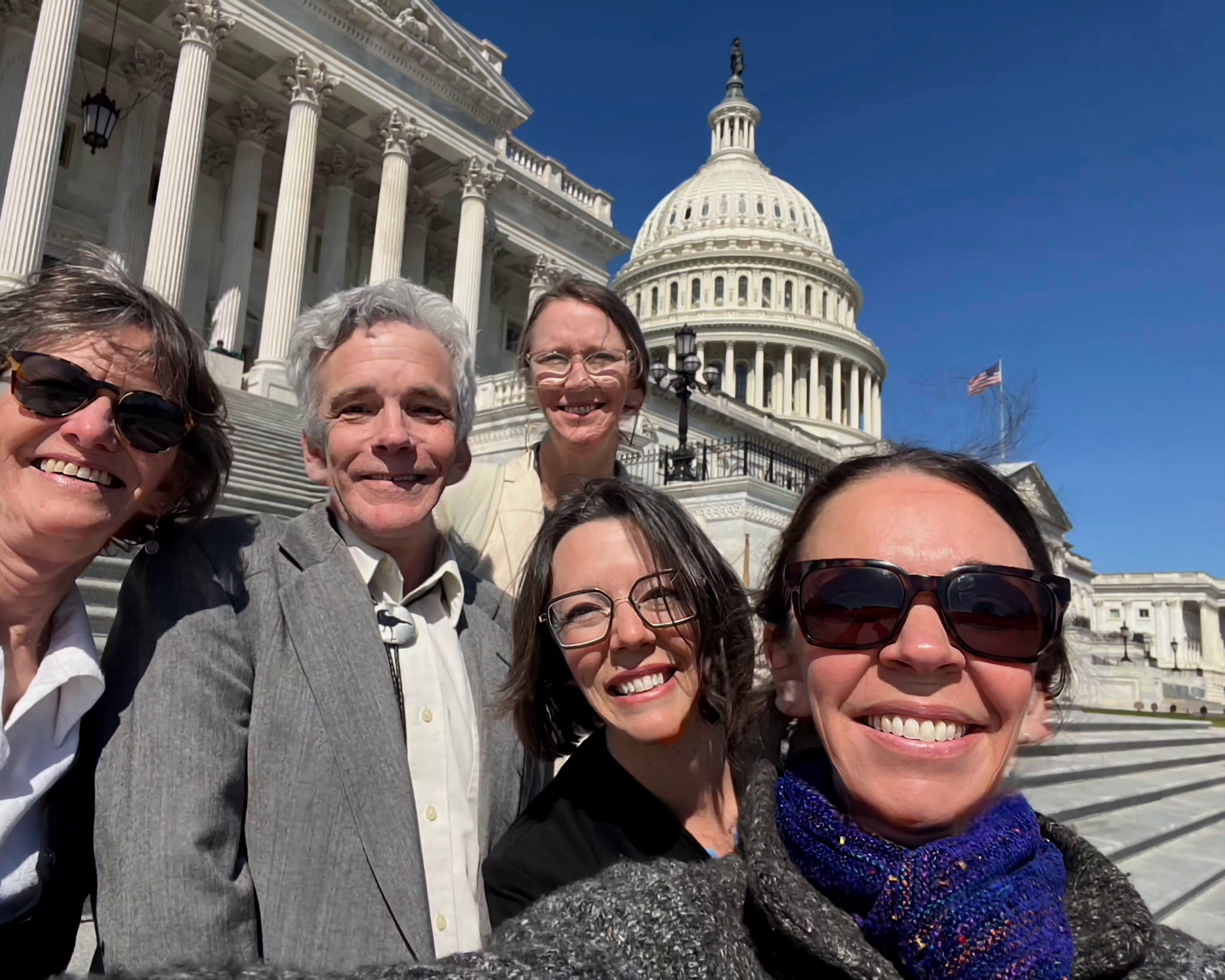
Representatives have returned to Western Colorado following the 14th annual North Fork Valley and Delta County DC fly-in. The delegation, composed of five community members, included representatives from Western Slope Conservation Center (WSCC), Valley Organic Growers Association (VOGA), and the renewable energy sector. This year, like others, the group advocated for Western Colorado conservation, public lands, farm policy, and clean energy.
A fly-in, as they are commonly referred to, is an organized event that involves traveling to Washington DC to advocate for specific issues. Oftentimes these are organized at the regional and national level; however, the North Fork and Delta County fly-in is unique because it’s coordinated on the local level and is self-directed. Members of the delegation request meetings with representatives and devise an agenda that is unique to the community’s needs and concerns.
Over the years, these efforts have made a difference. Relationships have been forged and deepened with Congressional members, staff members, and non-governmental organizations. Not only does the Delta County delegation eagerly await its opportunity to talk one-on-one with these officials, but the representatives, too, have come to expect the visit and look forward to hearing what the delegation brings to the table. They appreciate working together to identify homegrown solutions.
“For over a decade, community leaders from Delta County have left their fields, homes and offices to travel across the country, to bring their concerns and ideas to policymakers,” said Pete Kolbenschlag with Fulcrum Rural Solutions, who has helped lead the trip over the years. “This gets noticed. It impacts how people in DC look at their work and it helps make sure that our rural-rooted input can make a difference back here in Colorado.”
This year’s team of Delta County representatives included Tiffany Saverese of Osito Farms, Danielle Carre of Empowered Energy Systems, and Pete Kolbenschlag, Hannah Stevens, and Melissa Newell advocating on behalf of conservation, public lands, and the lower Gunnison watershed. The group represented a unified, Delta County vision that integrated the interests of small and medium sized sustainable agricultural businesses, renewable energy businesses, and conservation efforts to support public lands–on which the area’s outdoor recreation and agritourism industries rely.
This year’s fly-in focused on three main pillars: conservation, renewable energy, and agriculture, each framed in the context of the region’s immediate water crisis and anticipated summer drought.
Delta County is approximately 60% public lands, and keeping these lands and the sensitive North Fork Valley watershed healthy and intact is critical to the vitality of the area’s economy and rural way of life. In its meetings with representatives, the group emphasized the economic instability Delta County is susceptible to with the potential return of oil and gas development under the One Big Beautiful Bill Act and with the upcoming Draft Amendment release of the Uncompahgre Field Office Resource Management Plan.
WSCC advocacy coordinator Melissa Newell said, “As a rural county transitioning from a resource extraction economy, clean air and water, intact and connected wildlife habitat, and a healthy watershed are absolutely crucial to the resiliency of our region. Outdoor recreation, agriculture, and agritourism businesses rely upon the protection of these natural resources.”
Shortly after the group’s 2025 DC fly-in, the Gunnison Outdoor Resources Protection Act was introduced by both Colorado senators and Representative Hurd to Congress. This year’s trip served as an opportunity to thank these Congressmen for advancing the proposed legislation. A business letter of support, signed by 112 Colorado businesses, was hand-delivered to the representatives, underscoring the economic impact and benefits of protected public lands in Delta County.
As the effects of climate change and the rising costs of energy are felt in rural communities such as those in Delta County, it is ever more important for the area to develop a user-friendly path for clean energy to support homes, small businesses, and farming operations. Delegates reinforced that the pause of Rural Energy for America Program (REAP) grants makes clean energy systems for the North Fork less likely.
Further, the delegation stressed that recent USDA changes have steered support away from ground‑mounted and dual‑use solar array systems, sidelining agrivoltaics and community‑scale projects that could keep land in production and farm operations viable.
Agricultural businesses continue to be the backbone of Delta County’s economy. Conversations with Congressional representatives focused on the desire to strengthen the resilience of the small and medium sized (and oftentimes family-run) businesses in the county through investing in homegrown innovation, advancing local food security mechanisms, and strengthening local markets and services, especially in the face of staff reductions with such agencies as the National Resources Conservation Services (NRCS).
The delegation agrees that the trip was productive. According to WSCC executive director Hannah Stevens, “It was a real eye-opener, just to see how showing up–even as a constituent from a rural, small area that doesn’t necessarily get a lot of attention–means we can speak to the issues here directly with our representatives.”
The trip offered the unique opportunity to illustrate for Congressional members what is happening on the ground level. Although geographically remote and with a population of only 30,000+, Delta County is affected by what happens in Washington DC. This trip connected the dots between the grassroots, local efforts happening in Delta County with what is happening on Capitol Hill.
By showing up year after year in Washington, the work of the delegation from Delta County endures. Delivering a shared story of rural resilience achieved through collaborative solutions, the delegation proves that what is good for one benefits all.
Th
Leave a Reply